
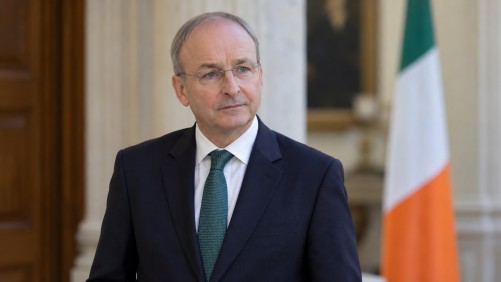
The controversy between the Republic of Ireland and Israel’s football associations could lead to diplomatic and sporting tensions, as Irish Prime Minister Micheál Martin has called for the withdrawal of recent remarks made by the Israel Football Association. The comments targeted Ireland’s national football manager, Heimir Hallgrímsson, who had controversially described upcoming matches against Israel in the Nations League as akin to “playing against genocide.”
Martin’s defense of Hallgrímsson’s remarks came during his visit to New York for the UN General Assembly, where he also highlighted humanitarian concerns in Gaza. The Prime Minister labeled the Israeli association’s response, which accused Hallgrímsson of “stupidity, ignorance and hypocrisy,” as “unacceptable.” He urged that these remarks be retracted to maintain diplomatic decorum.
The football matches between Ireland and Israel, set to take place on neutral grounds due to ongoing tensions, have already provoked public outcry in Ireland. Calls for a boycott have emerged from prominent Irish sports figures. Despite the protests, the Football Association of Ireland has confirmed that the games will proceed. They emphasize that withdrawing could lead to significant consequences for the national team in the UEFA Nations League.
The first encounter between the teams is set for September 27 in Debrecen, Hungary, followed by a second match on October 4 in Bačka Topola, Serbia, which will be held behind closed doors. The decision to host the games at neutral venues reflects the sensitive nature of the current political and humanitarian climate surrounding the fixtures.
This incident underscores the complex intersection of sports and international relations, as political discourse spills onto the football field. With attention now on how both nations will navigate these tensions, stakeholders from both sides will be watching closely to see how the situation unfolds, both on and off the pitch.