
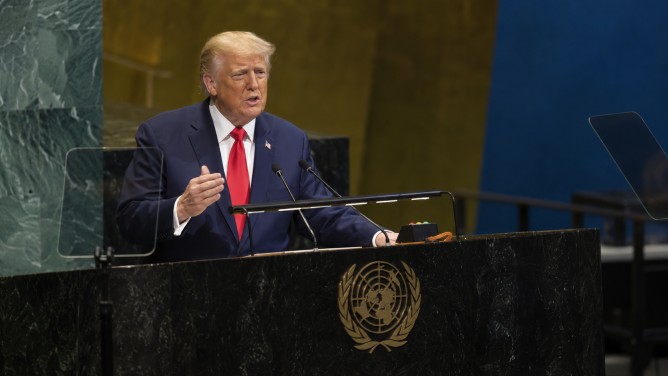
The international focus on economic stability and geopolitical tensions is set to intensify as President Donald Trump addresses the United Nations General Assembly, where he plans to discuss his administration’s military actions in Iran. This development could have significant implications for the global economy, particularly considering the ongoing disruptions in the Strait of Hormuz, a critical chokepoint for oil transportation.
In his speech, Trump is expected to defend U.S. military interventions while underscoring his dual approach of combining force with diplomacy. As the conflict with Iran continues to unfold, the president aims to assert that these measures bolster America’s standing on the world stage. The economic reverberations of these tensions have already been felt, with potential impacts on oil prices and international trade routes.
Additionally, Trump will likely highlight efforts to mediate the Gaza conflict, including initiatives aimed at disarming Hamas and reconstructing the region. Despite these diplomatic gestures, tangible progress remains elusive, leaving the region’s stability in question.
The address will also serve as a platform for Trump to critique international institutions, continuing a pattern of skepticism towards the United Nations since his return to power. His visit to New York provides opportunities for bilateral meetings with leaders such as Ukrainian President Volodymyr Zelenskyy and Japanese Prime Minister Sanae Takaichi, potentially shaping future diplomatic strategies.
Meanwhile, UN Secretary-General António Guterres is anticipated to address global conflicts in his opening remarks, with a particular focus on the rapid advancement of artificial intelligence. This broader discourse at the UN General Assembly underscores the multifaceted challenges facing the international community today.