
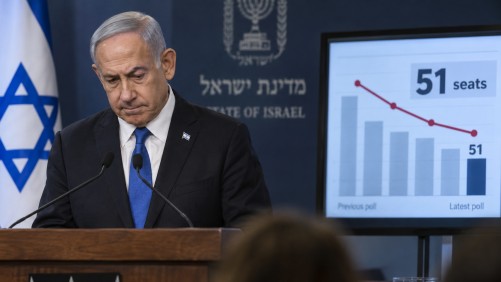
The latest poll results forecast a political deadlock in Israel, potentially complicating future governance as neither Prime Minister Benjamin Netanyahu’s bloc nor the main Zionist opposition are projected to secure a parliamentary majority in the upcoming elections. With Netanyahu’s bloc poised to gain 51 seats and the opposition bloc 55, the formation of a stable government remains uncertain, raising the possibility of protracted coalition negotiations or even another round of elections.
The poll, conducted with 500 respondents and a margin of error of 4.4 percentage points, highlights the challenging electoral landscape. Former IDF chief Gadi Eisenkot’s Yashar party is set to become the largest party in the Knesset with 24 seats. Meanwhile, Naftali Bennett’s B’Yachad is expected to secure 14 seats, followed by Yisrael Beytenu with nine, and the Democrats with eight. Within Netanyahu’s political bloc, Likud is expected to win 22 seats, with Shas gaining 10, United Torah Judaism nine, Otzma Yehudit seven, and Religious Zionism four.
The two Arab-majority parties, projected to win a combined 14 seats, could play a pivotal role in coalition-building, potentially tipping the balance in favor of either bloc seeking to form a government. This underscores the importance of their involvement in the broader political strategy for both Netanyahu and the opposition.
The poll also reveals a divided public opinion on the preferred outcome should the election result in a stalemate. Approximately 31.4% of respondents expressed support for holding another election, while 29.6% favored establishing a unity government. A minority government is the preference for 27% of those surveyed. Among Netanyahu’s base, a unity government is more popular, with 45.02% backing it, whereas those opposing him show a stronger inclination towards a minority government at 39.79%.
Several smaller parties, including Ofer Winter’s People of Israel, HaMiluimnikim, and Blue and White, failed to meet the 3.25% threshold needed to enter the Knesset, further complicating the political calculus. As the October 27 election date approaches, these dynamics reflect the fragile balance of power and the potential for significant shifts in Israel’s political landscape.