
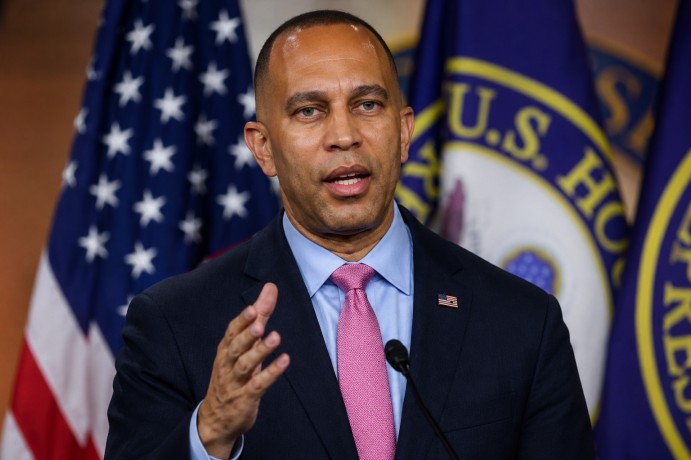
In a significant development within the Democratic Party, senior House Democrats have expressed their opposition to a proposed measure that seeks to halt $3.3 billion in U.S. aid to Israel. This stance underscores the internal divisions regarding support for Israel. House Minority Leader Hakeem Jeffries has declared his intention to vote against the amendment put forward by Republican Representative Thomas Massie, labeling it as “overly broad.” Jeffries warned that the measure might inadvertently hinder humanitarian assistance and undermine the fight against militant groups like Hamas and Hezbollah.
House Democratic Caucus Chair Pete Aguilar has also voiced his disapproval of the proposal, while simultaneously calling for a reassessment of U.S.-Israel relations. According to Aguilar, some of Israel’s current policies have led to its increasing isolation in the region. On the other hand, Congressional Progressive Caucus Chair Greg Casar has taken a different stance by advocating for the amendment. Casar contends that U.S. taxpayer dollars should no longer be used to support Israel’s military activities, urging the Democratic Party to adopt a revised strategy toward the Israeli-Palestinian conflict.
The debate unfolds against the backdrop of mounting pressure from voters and progressive lawmakers who are demanding changes to U.S. policy on Israel, particularly in light of the ongoing conflict in Gaza. This internal party discourse highlights the growing calls for a shift in the traditional U.S. approach to the Middle East.
Amid these discussions, Jeffries emphasized the need for a “major reset” in U.S.-Israel relations. While affirming Israel’s right to exist, he also advocated for the establishment of a Palestinian state. He suggested that future U.S. military assistance should adhere to human rights standards and take into account Israel’s economic capability to finance a larger portion of its defense requirements.