
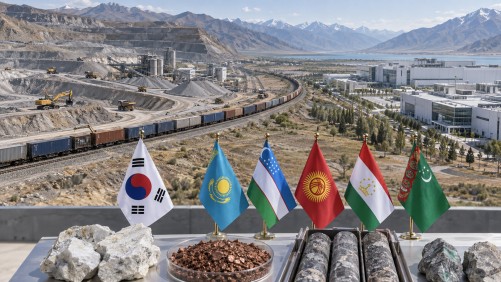
The newly forged cooperation between South Korea and Central Asian countries is set to significantly impact industries dependent on critical minerals. This partnership aims to bolster South Korea’s automotive, electronics, battery, and energy sectors with reliable mineral supplies, while offering Central Asian nations a pathway to advance beyond merely exporting raw materials by developing local processing capabilities.
During the inaugural South Korea–Central Asia summit in Seoul, over 70 agreements and memorandums were concluded, establishing a framework for further collaboration. A C5+1 forum for industry ministers was created, with the summit set to occur biennially. Central Asia, rich in mineral resources, provides an attractive opportunity for South Korea to leverage its expertise in exploration and advanced manufacturing, potentially covering the entire supply chain from mining to high-value production.
Uzbekistan has taken the lead by proposing an investment alliance focused on critical minerals and the creation of processing clusters that encompass exploration, mining, and production. Meanwhile, Kazakhstan has extended its hand for cooperation in rare metals, nuclear and clean energy, artificial intelligence, and infrastructure, while also aiming to strengthen its strategic ties with South Korea.
Countries like Kyrgyzstan and Tajikistan are also keen to engage with South Korea, particularly in minerals such as antimony and tungsten. Beyond mineral resources, South Korea is expanding its footprint in transport and infrastructure projects across the region, further solidifying its influence.
This growing interest from South Korea comes amidst increased competition from global powers like China, the United States, the European Union, and Japan, all seeking access to Central Asia’s critical mineral wealth. Central Asian governments are thus focusing on attracting investments that can catalyze local industrial production rather than just the export of raw materials.
The next South Korea–Central Asia summit is scheduled for 2028 in Kazakhstan, marking another step in this burgeoning partnership aimed at mutual economic growth and technological advancement.