
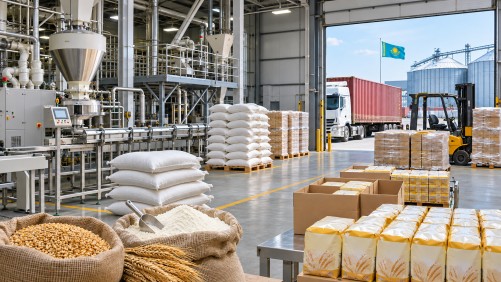
Kazakhstan’s processed agricultural exports surged by 35% to reach $3.4 billion, highlighting a growing global demand for the nation’s value-added food and agricultural products. This growth underscores a strategic shift within Kazakhstan to focus on processing raw agricultural materials domestically, a move that aims to yield higher economic returns than the export of unprocessed goods.
The importance of this shift was emphasized by Agriculture Minister Aidarbek Saparov, who stated that expanding the production and export of finished agricultural products is a key government priority. The rise in processed agricultural exports also contributed to an increase in their share of the country’s total agricultural exports, climbing from 51.3% to 53.3%.
Kazakhstan’s agricultural sector continues to be robust, with the production of approximately 18–20 million tonnes of wheat and 1–1.2 million tonnes of corn annually. This year’s corn harvest alone reached 1.7 million tonnes, presenting further opportunities for the food-processing industry to expand.
Currently, the country processes more than 5 million tonnes of grain annually, utilizing advanced deep-processing technologies for around 510,000 tonnes. In 2025, Kazakhstan produced 145,100 tonnes of starch products, reflecting a 21.8% increase from the previous year. Additionally, bioethanol production more than doubled to 21,000 tonnes year on year.
Looking ahead, the Agriculture Ministry has plans to establish six major wheat and corn processing facilities by 2029. These projects are expected to process 5.8 million tonnes of raw materials annually, further strengthening Kazakhstan’s agricultural processing industry and enhancing the value generated from domestic agricultural resources.